Showing posts with label Alan Moore. Show all posts

Sunday, 20 May 2012

Narrative, Drama and Sequential Art


(Brief statements modeled on Indian philosophical sutras.)

Narrative was spoken, then written.
Extra speakers and actions transformed spoken narrative into drama.
One picture can tell or imply a story.
Extra pictures transformed representational into sequential art.

Narrative, drama and sequential art are three story-telling media.
Pre-printing sequential art was rare.
An epic is a long heroic narrative poem.
A saga is an Icelandic heroic prose narrative.

The Gilgamesh epic was written on clay tablets four thousand years ago.
But can be read in paperback translation.
It addresses mortality.
And contains a polytheist flood story.

The Jahwist epic presented the Davidic monarchy as fulfilling the Abrahamic tradition.
The parallel Elohist epic was less anthropomorphic. 
The Mosaic books incorporate Jahwist, Elohist, priestly and legal sources.
The priestly source was post-Exilic.

"Moses and the prophets" is the narrative of a Law and its applications.
The Gospel narratives present Christ as fulfilling the Mosaic Law.
"Homer and the poets" are an epic poet and several dramatists.
Virgil's epic, the Aeneid, presents Rome as fulfilling Homeric myth.

The Roman Empire canonised Mosaic, prophetic and Christian, not Homeric, dramatic or Virgilian, texts.
Homer became the beginning of European secular literature.
Greek dramatists and philosophers reflected on myths.
Philosophers also initiated logic and science.

In Platonic philosophy, characters dramatically address each other.
In Aristotelian philosophy, the author prosaically addresses the reader.
Homer, the Eddas, the Vedas and the Shinto Records of Ancient Matters are definitive polytheist texts.
Milton applied epic and dramatic forms to Biblical content.

The Koran reproduces Biblical stories.
The Granth is hymns by Hindus, Muslims and Sikh gurus.
A novel is a long prose fiction.
Novels are historically "new".

Mainstream novels are realistic.
Genre novels are historical, romantic, Western, detective etc.
Fantasy novels re-present myths and legends.
Science fiction (sf) novels address speculative effects of science and technology.

"Sword and Sorcery" is a self-explanatory sub-genre of fantasy.
Space opera is action-adventure fiction with science fictional settings.
Edgar Rice Burroughs set "Sword and Science" on Mars.
Poul Anderson wrote speculative fiction, space opera, Sword and Science, fantasy and historical fiction.

CS Lewis' Ransom Trilogy and James Blish's After Such Knowledge Trilogy are fictitious sequels to the Bible.
However, Lewis was Anglican whereas Blish was agnostic.
Thus, God dies in Blish's Trilogy though not in Lewis'.
However, Lewis imaginatively considered the death of God in the fictitious correspondence, Letters to Malcolm.
 
The Greek dramatist Aeschlyus wrote Prometheus Bound.
The English poet Percy Shelley wrote Prometheus Unbound.
The English novelist Mary Shelley wrote Frankenstein, or The Modern Prometheus.
The British sf writer Brian Aldiss wrote Frankenstein Unbound.

Frankenstein is the pivotal character between Gothic Fiction and sf.
Superman is the pivotal character between sf and superheroes.
Cameras transformed stage drama into cinema.
Frankenstein, Superman and Frankenstein Unbound have been filmed, the third unsuccessfully (in my opinion).

Karel Capek's play RUR introduced the term "robot".
Isaac Asimov's "Frankenstein Complex" is fear of robotic rebellion.
Asimov's Laws of Robotics transformed Robots from Menace or Pathos into Engineering.
However, Asimov later revived, then synthesised, Menace and Pathos.

William Blake combined words with pictures.
His allegorical The Marriage of Heaven and Hell replied to Swedenborg's literalist Heaven and Hell.
CS Lewis' The Great Divorce replied to Blake and Swedenborg.
Following Plato, Dante etc, Lewis presents an imaginative visit to the hereafter.

Speech balloons and captions transformed sequential art into comic strips.
The earliest comics were comical.
However, they can mediate any content or genre.
A graphic novel is a long substantial comic strip.

Collected issues of a monthly comic book are often insubstantial.
The graphic adaptation of the novel Fahrenheit 451 is substantial but short.
The Killing Joke by Alan Moore is short but substantial.
It asks whether one bad day would drive us mad.

It also features the Batman fighting the Joker.
Consequently, the author has described it as insubstantial.
Definitive graphic novels are Watchmen by Alan Moore and The Dark Knight Returns by Frank Miller.
Both place superheroes in realistic settings.

"Superheroes" is a composite genre originating in comic books.       
Super powers may be scientifically or supernaturally based.
Also, masked avengers and costumed adventurers need not be super powered.
Thus, the genre combines sf, fantasy and action-adventure.

It presents modern heroic mythology.
However, comics by Garth Ennis, Art Spiegelman and Bryan Talbot address war, the Holocaust and child abuse, respectively.
There are at least two composite media.
Opera = drama + music.

Comics = representational art + story-telling.
A visual-verbal medium addresses right and left brains simultaneously.
Coloring and lay out may affect readers subliminally.
For example, a regular horizontal panel grid grounds fantastic or horrific content in a televisual/cinematic context.

Like prose, comics involve reading, turning and re-reading pages at the reader's pace.
Like screen drama, they involve sequential images.
However, careful readers miss no detail in a static image.
Each panel may contain captions, speech balloons, foreground and background.

Pictures and panel texts may resonate with or contradict each other.
Captions have replaced thought balloons.
A character's thoughts are revealed as he narrates a section of the story.
Captions can be color coded and written in different scripts.

Background includes titles on book shelves and graffiti on walls.
Thus, Superman source Gladiator by Wylie appears on a shelf in Watchmen.
"Coal not Dole" from the Great British Miners' Strike appears on a wall in Moore's Swamp Thing.
Lancaster Motorway Services appears in two otherwise dissimilar comics.

Narrative details may be non-verbal.
For example, an unknown background figure follows the central character through several panels...
Reading the words and glancing at foregrounds is insufficient.
A well written comic needs to be read at least twice.

Creative comics writers re-assess cliches.
Thus, Moore's Swamp Thing is not a conventional monster but the guardian of the environment.
Moore revived Marvelman as a journalist who dreams of flying but cannot remember his magic word...
Neil Gaiman's Sandman is not a superhero but the personification of Dream.

Substantial comics refer to prose literature.
Thus, Moore's The League of Extraordinary Gentlemen depicts Verne's Nautilus fighting Wells' Martians in the Thames.
In Gaiman's Sandman, Shakespeare's company performs A Midsummer Night's Dream for Oberon's court.
Gaiman's Lucifer Morningstar quotes, "Better to reign in Hell than serve in Heaven."

But he comments that Milton was blind.
Milton's personified Death was monstrous because begotten by Satan on personified Sin.
Gaiman's is beautiful because she defines life.
She complains that people fear her but not Dream who claims to be more terrible.

Personified Destruction abandons his realm when Newton asks whether light and matter are inter-convertible.
Personified Despair persuades the star god Rao to destroy a planet but allow one survivor.
Delirium that was Delight claims to know things that even Destiny does not.
Despair's devious twin, Desire, plots Dream's downfall...

Lucifer retires and becomes the title character of a series by Mike Carey.
Carey's God retires to be succeeded by his granddaughter, a British schoolgirl.
Blish's Satan had become God but offered the role to Man.
Thus, modern fantasy presents worthy sequels to myths and scriptures.

Special effects and CGI facilitate screen dramatisation of myth, sf, fantasy and superheroes.
Oral story-telling; recited epics and sagas; written narratives; prose fiction.
Spoken narrative; stage drama; screen drama; special effects.
Representational art; sequential art; comic strips; graphic novels.

Fictitious Sequels to the Bible

The Bible

Water is the primordial formless chaos. There are three successive universes. (i) Waters above and below are separated and the waters below are moved aside. Sky, sea and land are filled with lights, fish and animals, respectively. (ii) The Flood undoes creation but the Ark survives into the second universe, which we inhabit. (iii) The third universe will have no sea, thus no threatened return of chaos.

A Prequel

Paradise Lost by John Milton describes Heaven, Hell and Chaos before creation. Miltonic Chaos is formless matter, not liquid water.

A Scriptural Sequel

The Book of Mormon describes the Lost Tribes and the Risen Christ in North America.

Prose Fictitious Sequels

In C. S. Lewis’ Ransom Trilogy, a Christian warns the Venerian Eve not to disobey her creator and the Curse of Babel returns to Earth.1 In James Blish’s After Such Knowledge trilogy, Satan possibly creates a planet and definitely wins Armageddon.2,3 Blish writes that Dante saw, but Milton imagined, Satan. Blish’s universe is galactic, not Biblical.

Milton was unsure:

“…whether Heav’n move, or Earth…”4

Lewis fights a rearguard action, describing the translunar universe as theocentric and unFallen. Blish, writing as William Atheling Jr., comments that Lewis:

“…set out to impose upon the solar system a strange Anglican-cum-Babylonian theology and cosmogony, with amazingly convincing results despite Lewis’ decidedly foggy view of astronomy and most of the other sciences he seeks to diabolize.”5

Graphic Fictitious Sequels

Alan Moore’s adult comic strips present an angel who remained neutral during the Miltonic War in Heaven and witches who conjure the Original Darkness that was before the Creation.6,7 Neil Gaiman’s Sandman graphic novels confirm that Cain still dwells in the land of Nod, the Dreaming.8 For their role in the first story, Cain and Abel are given the guardianship of stories, particularly those published in the DC Comics horror titles, The House Of Mysteries and The House Of Secrets.
 
When Morpheus, Lord of Dreams, sends a message to Lucifer, Lord of Hell, Cain is the only messenger whom Lucifer will not harm. We see Cain’s Mark.8
 
Lucifer: “Still. ‘Better to reign in Hell, than serve in Heaven.’ Eh, little brother-killer?”
Cain: “Suh-certainly, Lord Lucifer. Whatever you say, Lord Lucifer.”
Lucifer: “We didn’t say it. Milton said it. And he was blind.” 9

Thus, four authors write worthy sequels to Paradise Lost and the Bible.
 
  1. C. S. Lewis, The Cosmic Trilogy (London: Pan Books, 1990).
  2. James Blish, A Case Of Conscience (Harmondsworth, Middlesex: Penguin Books Ltd, 1963).
  3. James Blish, Black Easter and The Day After Judgement (London: Arrow Books, 1981).
  4. John Milton, Paradise Lost/Paradise Regained/Samson Agonistes (New York: Collier Books, 1966), p.156.
  5. William Atheling Jr., The Issue At Hand (Chicago: Advent Publishers, 1967), p. 53.
  6. Alan Moore, Across The Universe: the DC Universe Stories of Alan Moore (New York: DC Comics, 2003), pp. 167-177.
  7. Alan Moore, Swamp Thing: A Murder Of Crows (New York: DC Comics, 2001).
  8. Neil Gaiman, The Sandman: Season Of Mists (London: Titan Books, 1992), Episode 1, p. 10.
  9. ibid, p. 20.


Revising the Origin Story


Every superhero, masked avenger, costumed adventurer and cosmic crusader has an origin story explaining how he acquired his powers and/or what motivated him to fight crime. The Lone Ranger's origin story is a classic. A band of Texas Rangers is ambushed, shot and left to die. One, nursed back to health by an Indian, survives, recovers and dons a mask to avenge the others. He could have been any of them: the Lone Ranger. The World War II Blackhawk Squadron comprised aviators of different nationalities each of whom had lost a family member to the Nazis. At least, I think each of them had lost a family member - unless I am now elaborating the myth. The Phantom is like a combination of Tarzan and the Batman with the extra dimension of many generations of Phantoms. Alan Moore's V wages a vendetta against those who imprisoned him in Room V of a concentration camp.

Origin stories can be revised or even completely changed when characters are revamped. Superman always comes from Krypton, grows up in Smallville and lives in Metropolis but all the details can change. Like everything else in comics, revamps have been done well, then overdone badly. DC Comics did it well to celebrate their fiftieth anniversary in the mid-'80's. Many major characters were renewed and their stories needed to be told for another fifty years, not changed again, yet again and even again as I write in September 2011. When a character is changed, the previous version should be satisfactorily concluded, not terminated mid-narrative.

The origin story, and I do mean "story," for Christian civilization was the New Testament. Hebrew prophets and Classical heroes were two series of prequels. In the Classical tradition:

Titans preceded Olympians;
the Titan Prometheus gave humanity civilizing arts;
the Argonauts saw Prometheus, bound by Olympians;
the Argonauts' sons fought at Troy;
Aeneas escaped from Troy;
his descendant, Romulus, founded the new Troy, Rome;
Caesar inspired the Roman Empire;
Constantine Christianized the Empire and moved its capital to Byzantium, renamed Constantinople.


Christ, identified with the Logos or "Word" (ret-conned from Greek philosophy to the Biblical creation), had fulfilled:

the promise to Abraham;
the priesthood of Melchizedek;
the Law of Moses;
the prophetic tradition as represented by Elijah;
the kingship of David;
the role of the Suffering Servant in Isaiah;
the role of the Son of Man in Daniel;
the roles of both purified priest and perfect victim in the sacrifice of atonement  -

- and had exercised divine power over the elements by calming a storm while walking on the waters that had been separated (we now realize by himself) at the creation. This comprehensively powerful being was able to cross-over from the Abrahamic tradition to the Promethean tradition and specifically to the Roman state religion, there to displace the Olympians who had bound Prometheus for civilizing mankind. The Homeric epics about the Trojan War and its Greek aftermath and the Virgilian epic about its Italian aftermath remained secular literary parallels to the Bible and Geoffrey of Monmouth presented the Kings of Britain, including the heroic Arthur, as descendants of Aeneas. To continue the comparison with comics, the epics resemble Golden Age back issues. (An alternative mythical history was presented by the Anglo-Israel theory that traced British monarchy back to the Lost Tribes.) 

Thus, Promethean and Abrahamic traditions converged in John, who identified Christ with Logos, and in Constantine, who Christianized the Empire. Coincidentally or otherwise, Alan Moore named a powerful fictitious magician John Constantine. If names have any power, then combining the names of the Fourth Evangelist and the first Christian Emperor, thus uniting spiritual and imperial power, must be powerful indeed. Moore's other contributions to these traditions were:

a personification of the original darkness that was before the creation;
an angel who remained neutral during the War in Heaven;
a feminization of Prometheus as "Promethea."

(Christian apologists ask: what was special about Jesus that made the earliest Christians apply every possible religious title to him? Marxists ask: what was special about social conditions that required a new ideology comprising a synthesis of all previously existing religious concepts? Christians claim that Jesus changed the world. Marxists argue that Gentile Christianity, mainly formulated by Paul, provided a unifying ideology for an already existing world empire. Paul supported slavery and a strong state.)

Narratives converge when comics publishers merge or when one company buys characters from another. Kal-El had come from Krypton in one fictitious universe. Shazam had empowered Billy Batson in an unrelated fictitious universe. Neither character existed in relation to the other despite competing for sales. Then the Superman publisher bought Captain Marvel. Now the two universes co-existed in one multiverse where interversal travel was possible so that the characters could meet. Almost anything can happen in fantastic fiction, as in religious belief. However, later changes to the multiverse strained plausibility beyond reason.

Superman's creators likened him to the Biblical strong man, Samson, and to the Classical strong man, Hercules. His Kryptonian name incorporates a Biblical word for a god, "El." The Mosaic divine name is incorporated in the names of Kal-El's Kryptonian father, Jor-El, and of his terrestrial foster father, Jonathan. Shazam combines the wisdom of the Biblical Solomon with the powers of several Classical gods and heroes, including Hercules. The Greeks had a wise man called not Solomon but Solon but this name would not have been known to Captain Marvel's readers or, probably, his creators.
 
To re-interpret Christian origins is to revise the origin story. We tell new stories in a familiar setting: 

Jesus did not die on the cross and revived in the tomb
or
the tomb was found empty because the body, buried hastily before the Sabbath, had already been moved elsewhere, perhaps back home to Galilee,
or
, like other crucifixion victims, he was buried in a mass grave and the tomb burial story originated in the oral tradition.
The man on the road to Emmaus was not Jesus...etc. 

But these are side-bar stories for post-Christian secular society whose prequels, starting with Thales, include Copernicus, Galileo, Newton, Darwin etc. Our world-view is part story, part knowledge, and the proportion that is knowledge has increased.


Literary Demons

Demons are fallen angels in fictitious works by C. S. Lewis, James Blish, Alan Moore and Neil Gaiman. The Christian Lewis additionally believed that demons literally existed. The magician Moore believes, I think, that they are projected negative emotions. All four writers agree in their fiction that souls are damned by their own choice although varying degrees of demonic temptation are also involved.

Gaiman’s Lucifer denies that he ever made any human being do anything or that he could own a soul.1 Blish’s Sabbath Goat says:

“MEN HAVE ALWAYS LED THEMSELVES UNTO ME.”2

However, Blish’s fictitious “Covenant” allows temptation up to, though not beyond, each individual’s ability to resist it. 

Lewis’ tempters try to fill their inner emptiness by consuming damned souls. Gaiman’s demons can consume souls, whether or not they need to. Unbelieving authors introduce change to the eternal realms: Blish’s Satan wins Armageddon; Gaiman’s Lucifer retires.

A fantasy author’s moral critique of fictitious but authentic characters remains valid whether or not the reader believes in the hereafter. The agnostic Blish valued Lewis’  fictitious accounts of temptation, Heaven and Hell for their moral perceptiveness.3 Thus, the powerful Biblical-Dantean-Miltonic literary tradition survives and continues to address issues crucial to human life.

  1. Neil Gaiman, The Sandman: Season Of Mists (London: Titan Books, 1992), Episode 2, p. 18.
  2. James Blish, Black Easter and The Day After Judgement (London: Arrow Books, 1981), p. 111.
  3. private correspondence.


Sacrifice and Resurrection in Faith and Fiction

Faith

Roman state polytheism became inadequate when the city ruled an empire. One world empire needed one omnipresent god, to replace local deities, and one perfect sacrifice, to replace local rituals. Judaism provided one god and several executed Messianic claimants. The Romans accepted the Jewish god as their god and one executed Messianic claimant as the perfect sacrificial victim. Saul of Tarsus, a Jewish Roman citizen, Romanized Judaism as “Christianity."

A minimal Christian creed would have been, “I believe in one god who accepts a recent death as a universal sacrifice.” The sacrifice had to be seen as a new revelation superseding ancient rituals so the death had to be a recent historical event, not just a reinterpreted myth. However, this particular death came to Saul’s (Paul’s) attention because the Messianic claimant’s disciples had already proclaimed his Resurrection. Therefore, the Resurrection also came to be regarded as historical. The minimal creed became, essentially, “I believe in one god who accepts a recent death as a universal sacrifice and resurrected the victim.”

Thus, the Christian historical synthesis incorporated both the barbaric belief in blood sacrifice and the perennial myth of death and resurrection, the former of necessity, the latter possibly by accident. Paul needed a sacrificial death. Peter provided a resurrection from death. Paul accepted the resurrection but interpreted the death as sacrificial. 

Sacrifice and resurrection are not necessarily connected. Most victims do not rise. All rising gods were not victims. They were connected in Christianity because the sacrifice atoned for sin which had caused death so atonement for sin entailed resurrection from death, but who now believes that sin caused death? Our experience is that gods, if they exist, do not require blood whereas death and renewal are perennial. Therefore, we need to consign blood sacrifice to the barbaric past but death and resurrection to the realm of myths, meaningful stories present in consciousness.

Some Christians acknowledge that the Resurrection is a “myth” in this sense while also believing that it was a historical event. When God became man, myth became history, although to say this is to invoke the further myth of incarnation. Thus, the minimal creed became that the one god accepts a sacrifice and resurrected the victim who was himself incarnate. This in turn led to a distinction between the persons performing the divine functions so that the formal creeds incorporated the Trinity: one tri-personal god who as the father accepts a sacrifice and resurrected the victim who was the son incarnate… The creeds also identify the father as the creator but this came straight from Genesis so did not need to be imported. Complicated, but synthesizing several pre-existing ideas.

Resurrection was historicized because Paul joined the Jesus movement, not the cult of any other historical figure. Despite its Roman origin, Christianity has adapted. The perceived need for blood sacrifice remains meaningful to Evangelicals because it fantastically reflects our common experience of alienation. 

Graphic Fiction

The death and resurrection myth, instantiated in other gods before Jesus, is now instantiated in fictitious characters. In “cliff-hanger” cinema serials, the hero seemed to die at the end of each episode except the last. In one comic book adaptation, Flash Gordon is suffocated in a giant hour glass publicly displayed by Ming of Mongo. Flash’s friends cannot rescue him from the closely watched and guarded hour glass but do retrieve and revive his body later. Thus, in this case, there is a real death and resurrection.

Sherlock Holmes, James Bond, Superman and others have all fallen off the cliff, literally or metaphorically, at the end of one volume but have returned in subsequent volumes and were last seen alive. A fantasy character’s death can be literal. Superman’s soul entered the hereafter but his foster father, during a near death experience, persuaded him to return. In this case, the editors and authors had planned an extended series about the supporting characters while the hero was dead but had always intended to restore him although by a roundabout route, with none of the four pretenders turning out to be the real steel deal although we were misdirected into thinking that one of them was so that it became necessary to re-read in order to check when we had been seeing the revived Kal-El and when we had instead been seeing a Kryptonian artificial intelligence that mistakenly thought itself to be Kal-El.

In a different version of this story, such an intelligence might have sufficed as the resurrected Superman. If an organism cannot survive indefinitely, might its memories and sense of identity be transmitted into a different medium? (St Paul claimed that the resurrected spiritual body differs qualitatively from the buried physical body.)

Lex Luthor, dying of radiation poisoning, convinced both characters and readers that he had killed himself by crashing a plane and had been replaced, a year later, by his illegitimate and previously unknown son, only to reveal that the “son” was Luthor’s preserved brain with a new body grown around it. Another way to handle this scenario would have been for a genuine son, Lex II, to become “Luthor.”

Between John Byrne’s revamp of the character in 1986 and Superman’s return from death in 1993, the Superman titles were worth reading although they never realized their full potential and deteriorated drastically later, quantity overcoming quality, the industry destroying the medium. I expected to collect the second fifty years, 1988-2038, which would have generated storage problems, but continuing the collection became a pointless waste of money and paper, although the character remains capable of innovative treatment, for example in the Smallville TV series and novels based on it. 

When a character is published indefinitely for decades, his story not only risks deterioration but also necessarily branches into different “continuities.” For example, the Superman of the 1940’s fought in World War II whereas the current Superman did not. Earlier versions of the character, regarded as inhabiting parallel universes, can also be regarded as having died by now. Thus, we know that one character, in different versions, has died yet is always currently active. 

The one-off “imaginary stories,” not obliged to conform to continuity, include one in which Superman was killed and did not return although his cousin faked his resurrection when arresting his murderer, Luthor. Alan Moore’s imaginary story, “Whatever Happened To The Man Of Tomorrow?,” written to conclude the post-War, pre-Byrne continuity, convinces the reader that Superman has died, then reveals that he has survived under a changed name without his powers but with a son who inherits the powers.

Once, Superman prosecuted and the Batman defended Lana Lang for the murder of Lois Lane. Lois looked dead but I did not find Part II which would either have shown her return or explained why she had not died after all. If a resurrected Lois really had died, then perhaps a murder charge could be made to stick although it would be difficult to prove in the presence of a living body. Lois cannot die permanently. She has married Clark in four comics continuities and one TV series.

When Moore took over writing the minor horror title, Swamp Thing, he had the character apparently killed by a military attack only to show that bullets and shells can stun but not kill a vegetable body. Later, Swampy’s body died from radiation poisoning but he grew another. Surviving as a disembodied consciousness in a vegetable dimension called “the Green,” he was able not only to control vegetation and to grow new bodies of different sizes and shapes but also to enter the hereafter, rescue his lover’s soul from Hell, where it had been unjustly imprisoned, and return it to her still living but unconscious body.

An Alan Moore story begins with Superman expecting to die from a Kryptonian fever but Swampy helps him through it. Luthor, an expert in the attempted destruction of an invulnerable being, advises a secret government agency on how to kill the Swamp Thing. Consequently, Swampy is apparently dead for two issues, while there is mourning and a memorial service on Earth, but he is really adrift in space, bouncing between inhabited planets, and returns to kill the covert team that had tried to kill him. After Moore’s run on the title, Swampy learns of Luthor’s involvement and pursues him as well but Lex, like every Metropolitan, is protected by Superman so Swampy backs off.

Lex is a continuing character who cannot die permanently, except in an imaginary story or “Elseworld,” but he has over time become a different character. He was a wanted criminal and frequent convict but now has “always been” a respectable though crooked billionaire-philanthropist who even became US President. The nature and extent of Superman’s powers has changed more than once and his character changes with his powers. Each distinct version of a character has a limited life-span but we usually see one version morphing into his successor rather than one ending and the next beginning. Even when Moore concluded one Superman continuity and Byrne initiated its successor, the pre-Byrne Superman appeared anachronistically after the cosmos-altering “Crisis” which was supposed to have effected a smooth transition between continuities.

Also under Moore’s successor, an attack from space apparently killed the Swamp Thing only to send him backwards in time. He interacted with historical figures (including Jesus as a powerful white magician but the publishers refused to publish this episode), met himself returning to the twentieth century, founded the line of plant elementals of which he is a member and returned to the twentieth century, meeting himself traveling backwards and arriving a few months after his departure, thus unable to help oppose the invading aliens that had tried to kill him. 

This summary shows the death and resurrection theme recurring several times for just two characters, Superman and the Swamp Thing. 

Prose Fiction

A realistic character’s “death” can only be apparent but can also be convincing. Doyle’s attempts to end the Holmes series included a literal death. Watson married and left Baker St at the end of the second novel. The married Watson stayed in touch with Holmes but then Holmes died at the end of a second collection. Two further novels recorded earlier cases. In a third collection, Holmes returned from apparent death but then retired. In the fourth collection, Holmes returned from retirement but only temporarily. A final collection recorded earlier cases and one during the retirement but then Doyle, the omnipotent author, said, “This must cease,” although he did not resort to another death. Appropriately, we last see Holmes still active in Baker St. As Holmes returned from Reichenbach, so might Moriarty. Both John Gardner and Alan Moore have made this assumption.

Bond seems to the reader, and was originally intended by the author, to be dead at the end of his fifth novel, is believed by other characters to be dead at the end of his eleventh novel and is shot in the stomach, so would have died unless rescued in time, near the end of his twelfth and last novel. His “Obituary,” near the end of the eleventh novel, You Only Live Twice, reduces his life by more than a decade so that he remains not only alive but also active longer than expected. “Obit:” rationalizes its contradiction of dates as given in the first novel by relegating the entire series up to that point to the status of fictionalized accounts written by a former colleague. Retroactively, previous volumes become, in dramatic terms, “plays within the play” or, in scriptural terms, Apocrypha.
  
Fleming’s subtle rewriting of the character’s career established in popular consciousness the myth of a perennially active hero, a myth perpetuated to absurdity by post-Fleming novels and additionally vulgarized by endless slapstick films. Since we are discussing myths as they appear either in religious belief or in popular fiction, the artistic contrast between Fleming’s Bond novels and the post-Fleming Bond films parallels the religious contrast between mystical subtlety and Evangelical vulgarity.

Both Doyle and Fleming had intended an irrevocable death but the logic of series fiction is that a popular character either does not die or returns, his “death” becoming not an ending but a major turning point. The Ministry of Defence switchboard receives calls from imposters after Bond’s publicly announced death. When he does return, initially mistaken for another imposter, he is not himself and does not regain his former status within the Secret Service until the end of this last book. The film, You Only Live Twice, with a different agenda and an unrelated script, shows an apparent death and naval burial at sea, then immediately shows how these were faked so that Bond could pursue his enemies without their knowledge. In the following film, Blofeld, evading a vengeful Bond, fakes his death at Bond’s hands by employing a double.
Doyle recorded earlier cases before resorting to The Return…, complete with a “man on the road to Emmaus” scene, whereas Fleming, writing each novel as a direct sequel to its predecessor, had to explain Bond’s survival early in the sixth novel but, even then, Chapter I, describing familiar characters in a familiar setting, avoids reference to Bond as if the world were continuing without him.

Raffles pulled a “road to Emmaus” stunt, attending his own funeral in disguise, on television but I cannot remember whether this scene was in the original Raffles series, having read the latter only once. This does not matter here because the present article is reflective, not researched. It evokes memories of resurrection images in popular fiction and in different media. The Flash Gordon story above is a beaut and one that I might well not have known about. What else is out there? 

Television and Time Travel

I read of a TV series that handled the death and resurrection theme with originality. The actor playing Robin Hood was not due to return for a second season. At the end of the first season, Robin dies. In the second season, a nobleman called Robert joins the merry men, becomes their leader and comes to be called “Robin.” We are to understand that the Robins merged in the legend which is in any case inconsistent. Thus, continuity is maintained, contradictions are explained and a real death does not end the story of Robin Hood, as indeed it cannot. This approach would have accommodated even the death of the first actor, which, fortunately, had not happened.

The time traveling “Doctor” explains changes of actor and longevity of the character by “regeneration,” periodic rejuvenation, which is easily invoked in a science fiction (sf) context. One early regeneration was treated very like a death and resurrection. However, the story of the Doctor needs to be retold from the beginning with Time Lords as future humanity, not an alien species, and with a subtler understanding of the relationships between life, death and time travel. A time traveller who has died is not dead all the time if, before dying, he had made extended excursions to periods later than the date of his death. (See The Time Traveler’s Wife by Audrey Niffeneger.) It would be possible to show in chronological order the Doctor’s adventures, then his death, then more of his adventures. The second set of adventures would be after his death to non-time traveling characters but before it to the Doctor himself. 
The British sf writer, Christopher Priest, once said publicly that he had written a script featuring a death of the Doctor that was not subsequently prevented or explained away. It was a real, not an apparent, death. I do not think that that script was used although, not being a big Who fan, I am not certain. Such unpublished and apocryphal stories add extra dimensions to legendary characters.

A time traveller would be able to fake a resurrection or ghostly apparition by learning the time of his death, then making a brief appearance after it. (See The Shield Of Time by Poul Anderson.)

The Doctor is currently described as “the last Time Lord.” This means not only that other Time Lords have died but also that he no longer meets them wherever or whenever he travels. However, if they were all killed in, for the sake of argument, 2000 AD, then a journey to 1999 or earlier will take him to a time when they were still alive. Further, if they, as time travelers, had visited periods later than 2000, then some of them may be around now (2008) and certainly are in the future. If, as is suggested, they died in a “Time War” and if, as seems probable, such a war involves time travel, with battles in different periods, then it is questionable whether they could all have died at a single time. Some of their deaths, or at least some of the Time War battles, could be still to come.

In any case, from a four dimensional perspective, everyone, whether a time traveler or not, is alive at some times and dead at others so no one is permanently dead to a time traveler, even before we ask whether it is possible to change events by preventing deaths, an issue that Doctor Who made a complete mess out of. It demands subtlety. A Time Patroller was seen to fall into a waterfall and records showed that she had never returned to her home base or to anywhen else so a colleague from a different era rescued her, then proposed to her, thus explaining why there was no further record of her under her maiden name. (See The Time Patrol by Poul Anderson.) The second Patroller changed not known events but their significance. Without his further action, her absence, under her maiden name, from subsequent records would have been caused by her death in the waterfall, not by her marriage to him, but Patrollers are forbidden to prevent deaths that are definitely known to have occurred, for example when the body has been found.

Breaking this rule would generate not one timeline with a death and resurrection but a first timeline with a death and a second with a prevention of the death. The Time Patrol is committed to preserving a single timeline. Cyrus the Great was killed as a baby. When he was needed as an heir in adulthood, a captured Time Patroller was forced to play the role. In order to be able to return home to the twentieth century, that Patroller with a colleague prevented the killing of the infant Cyrus so that the right guy played this historically necessary role after all. (The Time Patrol.

The Time Patrol exists in the same timeline as Holmes and must prevent him from detecting their activities in his era but I suggest that they would consult him in his retirement when there would no longer be any risk that their interaction with Holmes would affect Watson’s accounts of the detective’s adventures. These are historical accounts so the Patrol has to preserve them as they stand, including the one piece of evidence for time travel that is in there, but Patrollers might also need Holmes’ expertise to investigate a case concerning Jonathan Wild, the master criminal of the previous century, whom Holmes compares with Moriarty.

In another TV/film sf series, of course, Spock died and returned. Part of the process was the finding of an empty coffin with an abandoned burial shroud. (Spock should be re-written as a descendant of human extra-solar colonists, not as a human-alien hybrid. Since Vulcan was a hypothetical, although non-existent, solar planet, it is questionable whether that name should have been applied to a fictitious extra-solar planet but that is now a lost battle. "Vulcan” popularly means Spock’s home planet.) The series continued long enough to incorporate a real death of Captain Kirk without a resurrection although, even then, Kirk spent some time in another realm between his historically recorded death and his actual death.

Conclusion

This article began with the realization that sacrifice and resurrection are separable concepts in Christianity, then pursued resurrection in unexpected directions. Whenever we appreciate a work of fiction in which the hero dies or appears to die but is alive later, the myth remains active as it was in Adonis, Balder, Christ and Osiris. (The Norse gods failed to rescue Balder from Hel (= Hades, not Hell) but he will return after the Ragnarok when Odin, Thor and Loki have died.)

Sacrificial death and resurrection survive in Evangelical sermons. Self-sacrifice, death and resurrection recur in heroic fiction. Marxists hope to end the conditions that generate both Evangelism and nationalism but not to end appreciation of myth or fiction. I think that we will fully understand the Four Gospels and, for example, the James Bond novels when we have transcended current conflicts so that contentious issues no longer include the historicity of the Resurrection, the nature of alienation, the need for atonement, sexual morality or Cold War politics. We will then appreciate these texts without having to argue against contrary views and will instead debate the merits of as yet unwritten works, of which some will continue to express perennial myths though in new ways. Societies change but life and death are constants.


Saturday, 19 May 2012

Fictions


There are at least four levels of fiction:

(i) acknowledged fiction, requiring willing suspension of disbelief;
(ii) private imaginings and fantasies;
(iii) religious "higher fictions", requiring willing belief; (1)
(iv) everyday social fictions, including names, money, laws, rights etc.

I know my name because I remember that I have always been addressed by a particular sound which could have been different. Thus, the sound is arbitrary although I unconsciously identify with it.

It is notorious that, if everyone tried to take their money out of the bank simultaneously, there would not be enough. A bank balance is as fictitious as a comic strip. However, it does regulate real interactions between people called, eg, investors, employees and consumers. Marvel invests in a Thor film and I pay to see it. Thus, the investors control what a lot of people do and the consumers enjoy particular experiences. Hopefully, the production, presentation and appreciation of art including drama will in future be organised in ways that do not involve the problems generated by the fiction of money.

I have pension rights only because and as long as a lot of people agree that I have. We generate a social realm of laws and rights just as a theatre company generates the dramatic realm of Elsinore. The natural realm includes the laws of gravity and motion but no laws protecting rights or property. We live in the natural realm, imagine other realms, then live in them. We are amino acids with imagination. (2)  Catholics live not only in secular history but also in a "history of salvation". Having been brought up with Catholic morality, I now think that, if I imagine a sexual partner, then I engage in essentially the same fiction-building exercise as peasants visualising the Virgin. 

Some of us need to return to Pagan routes in order to come forward into...I suggest, Buddhist meditation and Marxist politics. Pagan and Buddhist myths can be acknowledged as meaningful stories. An Ysan character in The King of Ys: Roma Mater by Poul and Karen Anderson says, "...we...do not take ancestral myths for literal truth, as if we were Christians. They are symbols." (3)

As Indian philosophers say, we need to discriminate between the real and the unreal. We also need to recognise and value fiction and there may be a lot more of it than we realise. When someone spins a yarn not to deceive but to entertain, is this a fiction or a lie? When I am asked, "And you believed him?", I feel not that I have been lied to but that I have been stupid, have failed to discriminate between real and unreal.

(1) Alan Moore in conversation.
(2) Alan Moore in Promethea.
(3) Anderson, Poul and Karen, The King of Ys: Roma Mater, London, 1988, p. 326.


Friday, 18 May 2012

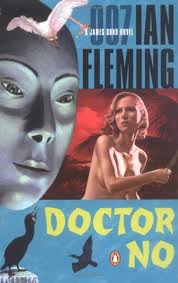
007, No 6 and V

007 = 7; No 6 = 6; V = 5 in Roman numerals. Thus: 7, 6, 5.

007 is James Bond in novels by Ian Fleming and his successors and in films starring Sean Connery and his successors. No 6 is the title character of Patrick McGoohan's The Prisoner TV series. V is the title character of Alan Moore's V for Vendetta graphic novel. (Three characters in four media: prose fiction (verbal); large and small screen drama (audiovisual); sequential art (visual-verbal).)

McGoohan borrowed from the James Bond films the idea of a powerful secret organisation with numbered members controlled by a mysterious "Number One." Moore did not borrow from McGoohan but did produce a parallel text addressing common themes. No 6 was so called because he was imprisoned in an island "Village" where he and his cottage were numbered 6. V was so called because he was imprisoned in Room V of a concentration camp. Later, fascist Britain resembled an island prison. V, a vendetta-waging anarchist terrorist, challenged the authorities as No 6 had challenged successive No 2's and the hidden No 1 in the Village. V was inspired by a letter passed between cells through a hole in the wall by the woman in Room IV. (Maintaining the numerical progression, Bond refers to a colleague numbered 008 and V refers to his fellow prisoner in Room IV.) We know of V only that he is male, not whether he is black, Jewish or homosexual or whether he was politically radical before his imprisonment.

Moore simultaneously wrote Marvelman and V, a superhero and a masked avenger, for Warrior magazine. Marvelman was directly descended, via Captain Marvel, from Superman whereas V was not directly descended from the archetypal comic book masked avenger, the Batman, although a Batman "Elseworld" story did show Wayne opposing an American dictatorship in an alternative history. V's appearance is based on that attributed to Guy Fawkes and he completes the job attempted by Fawkes. Like the Lone Ranger, V remains masked throughout. His face is unseen by the reader and even by his close assistant. In this respect at least, he also resembles Judge Dredd, a legalized vigilante in a futuristic city. (Moore also wrote an unpublished Dredd script, a "last Superman story" and a pivotal Batman/Joker story.)

In the Village, names are replaced by numbers but faces are not usually masked. When, in the episode "A, B and C," letters replace numbers, the previously unknown C leads No 6 to the masked D who, when unmasked, turns out to be the current No 2, but this occurs within an induced dream, thus in a "play within the play." In the concluding episode, No 6, unmasking No 1, significantly sees his own face. Prospero played by Vincent Price in the film The Masque of the Red Death had the same experience when he unmasked a red-garbed intruder who was his own personalized death.

At the end of V for Vendetta, V's assistant, Evey, does not unmask the dead V but realizes that her face must be behind the mask. She becomes V. His sabotage and assassinations have overthrown fascism. She hopefully will oversee without needing to intervene in the growth of freedom. But, like Asimov's Second Foundation, she and her new assistant will be able to intervene if necessary. In The Foundation Trilogy, an unpredictable mutant disrupted Seldon's Plan but the hidden Second Foundation existed to guard and restore the Plan. After the events of V for Vendetta, neo-fascists could seek to regain control. Evey/V might be able to prevent counter-revolution by encouraging more popular action. (She will not continue V1's strategy of individual assassinations.)

Bond conventionally contends with agents of a foreign dictatorship but does not change himself. The self-sufficient No 6 potentially frees himself. V, inspired by Valerie, and helped and succeeded by Evey, potentially frees society. Thus, the successive series form a progressive conceptual tetralogy:
 
first, Ian Fleming's twelve James Bond novels in which Bond mainly opposes Russian Intelligence (in fact, SPECTRE involvement in three of Fleming's later novels is film-derived); 

second, the first five Sean Connery James Bond films culminating in Bond's meeting with No 1, Ernst Stavro Blofeld, plus two further films with Blofeld as the acknowledged villain;

 
third, the seventeen episode Prisoner TV series culminating in the Prisoner's realization that he is the unmasked No 1;


fourth, the V for Vendetta graphic novel culminating in Evey's realization that she must be the masked V.

I exclude post-Fleming Bond novels, post-Connery Bond films, Prisoner spin-offs and the V for Vendetta film. At the time of writing, December 2009, I have not yet seen the new Prisoner TV series.


Who is V? When leading Evey to the roof of the building at the moment of her psychological liberation, he resembles a robed Christ but we should not regard a multiple manipulator and murderer as the Messiah. When addressing the public on video, he speaks as if he were mankind's creator but this is ironic. It has been suggested that V is Marvelman, who is deified in his own series. The only evidence for this identification, I think, is that, when seen in silhouette before donning the mask, V seems to be crew cut. Both V and MM result from, very different, government experiments. V's experience motivates him to overthrow that government. MM and his Pantheon are so powerful that they effortlessly displace the nuclear powers and the UN. V destroys a dystopia. MM builds a utopia. Their stories are complementary, not convergent. Like Superman (day) and Batman (night), they are archetypal opposites.
 
The anarchist V opposes all governments but has additional personal reasons to resist Norse Fire. He assassinates individuals not only because of their present positions in the state apparatus but also because of their past dealings with the man in Room V. For example, he forces the Bishop of London to consume a poisoned Communion wafer. The Bishop, who preached sermons dictated by the Fate computer to congregations including high Party members, had also previously been the concentration camp chaplain.

Much of the characterization, dialogue and plot in V for Vendetta is realistic but V's omniscience about the other characters is surreal. On the one hand, he is a particular character whose face was seen by his captors, though not by us, in the concentration camp. On the other hand, he is endlessly resourceful and manipulative and supremely confident that the state police will not find him hidden in the heart of London. Only the disaffected detective is going to find him and V somehow knows what the outcome of that encounter will be. He knows which Party widow will assassinate the Leader. Only the author can know so much about the characters. 
 
Authors can be incarnated in their stories. Very occasionally, the first person narrator really is the author. For example, CS Lewis exchanges letters with Ransom at the end of the first Ransom novel and meets him at the beginning of the second. But incarnated authors need not be narrators. The comic strip is mostly un-narrated and Alan Moore's incarnation in it is masked. Evey cannot see his face because she would have to look off the page to do so.