From Page to Screen
 Ian Fleming's twelve James Bond novels
inspired many screen adaptations, imitations and parodies. One parodic
imitation, with some input from Fleming, was The Man From UNCLE TV
series. Danger Man, a pre-Bond TV spy series joined the Bond-wagon.
The Prisoner, a post-Bond Danger Man sequel, featured
high-tech intelligence-gathering and a powerful secret organisation with
numbered members controlled by a mysterious "Number One," like
the criminal organization SPECTRE in the James Bond films.
This article focuses on the Bond novels and on these three TV series.
Ian Fleming's twelve James Bond novels
inspired many screen adaptations, imitations and parodies. One parodic
imitation, with some input from Fleming, was The Man From UNCLE TV
series. Danger Man, a pre-Bond TV spy series joined the Bond-wagon.
The Prisoner, a post-Bond Danger Man sequel, featured
high-tech intelligence-gathering and a powerful secret organisation with
numbered members controlled by a mysterious "Number One," like
the criminal organization SPECTRE in the James Bond films.
This article focuses on the Bond novels and on these three TV series.
From Screen to Page
 Adaptations from screen to prose have
been less creative. There are novelizations of films and original novels based
on TV series. UNCLE novels came first but were poorly written. David McDaniel's
UNCLE novels presented a history for the villainous
organization, THRUSH, deriving it from the main villain of the Sherlock Holmes
series. The Prisoner was
complete as a screen drama and did not need three novels, one by McDaniel, as
sequels. (Years later, better written Smallville novels read like new
episodes of the Smallville TV series.)
Adaptations from screen to prose have
been less creative. There are novelizations of films and original novels based
on TV series. UNCLE novels came first but were poorly written. David McDaniel's
UNCLE novels presented a history for the villainous
organization, THRUSH, deriving it from the main villain of the Sherlock Holmes
series. The Prisoner was
complete as a screen drama and did not need three novels, one by McDaniel, as
sequels. (Years later, better written Smallville novels read like new
episodes of the Smallville TV series.)
From Screen Treatment to Page
 Several authors have written
prose and screen versions simultaneously: L Frank Baum (Oz); Arthur
C Clarke (2001); Ian Fleming
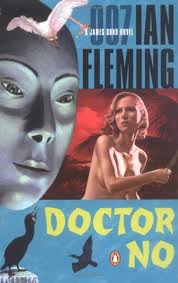
(Bond). The novel, Dr No, and
the collection, For Your Eyes Only, were each based on a proposed TV
series. The novel, Thunderball, was based on a feature film treatment. Thus, some page-screen interactions are
"behind the scenes."
Several authors have written
prose and screen versions simultaneously: L Frank Baum (Oz); Arthur
C Clarke (2001); Ian Fleming
(Bond). The novel, Dr No, and
the collection, For Your Eyes Only, were each based on a proposed TV
series. The novel, Thunderball, was based on a feature film treatment. Thus, some page-screen interactions are
"behind the scenes."
Cyclical Summaries
James Bond
novels:
(i) Defeated by Bond, the Russian
organization, SMERSH, disbands and some of its members join
the independent organization, SPECTRE;
(ii) Bond destroys SPECTRE twice but its founder and chairman, Blofeld, known in
the films as "Number One," escapes
both times;
(iii) Bond kills Blofeld and re-engages Russian Intelligence.
UNCLE/The Return of The Man From UNCLE:
(i) Defeated by Napoleon Solo and Illya Kuryakin, the
independent organization, THRUSH, disbands and a leading member is imprisoned;
(ii) Waverly dies, Solo retires, Kuryakin resigns, time passes;
(iii) The prisoner escapes, THRUSH is re-formed, UNCLE's new Director contacts
Solo...
Danger Man/The Prisoner:
(i) Defeated by John Drake, Russian Intelligence
survives;
(ii) a secret agent resigns but is immediately imprisoned by order of "Number
One";
(iii a) the Prisoner realizes his identity and escapes but
(pessimistically) only temporarily;
(iii b) the Prisoner realizes his identity and (optimistically) permanently escapes from an otherwise endless cycle.
Bond defeats Russian Intelligence, including
its enforcement arm SMERSH, several times. UNCLE and Drake defeat their enemies
many times. "...several..." and "...many..." reflect the difference in number of
episodes between a series of novels and a TV series. Independent organizations
as collective villains reflect detente. Bond and UNCLE end where they
started. Only The
Prisoner is ambiguous. The imprisoned former secret agent may or may
not be Drake and may or may not escape permanently.
Patrick MacNee played John Steed in The Avengers TV series,
Sir John Raleigh, the new UNCLE Director in The Return, and Tebbit, Bond's assistant in a
later film, but these are different characters. Patrick McGoohan played Drake
and the Prisoner but denied that they were the same character possibly for
copyright reasons. The clear continuity between the two series implies that the
characters are identical. Ingenious steps are taken to avoid naming the
Prisoner. An Intelligence officer's daughter confronts her father with the
accusation that he, the father, knows where "he" is to which the father
replies, "I take it you are referring to your fiancee?" When claiming to be the
rightful occupant of a London flat and owner of the car parked outside it, the
Prisoner, asked his name, unaccountably pauses and offers what is clearly a
false name, "Peter Smith." He has to think to avoid using the commoner "John
Smith."
On the other hand, at least twice in
The Prisoner, one actor does play two characters in different episodes.
The Bond Novels
We have come a long way but are back where we
started. SMERSH, SPECTRE and Blofeld are no more but Russian Intelligence
remains and other opponents would have replaced it if Fleming had lived longer
and had continued writing. A seven-volume SMERSH cycle and a five-volume
SPECTRE/Blofeld/aftermath cycle are complete and a third cycle could have
followed. Insofar as Bond had become a mythical
figure, the cyclical structure of the series might express an eternal
recurrence. A character like Bond exists only to fight villainous organizations. Thus, he always defeats yet ever
re-fights them. Fleming does not set out to say this but simply demonstrates it
by writing the series.
When the first four novels had not (yet)
been as successful as Fleming had hoped, he had planned to complete the series
as a
single five-volume cycle culminating not only in the expectable defeat of SMERSH
but also in the unexpected death of Bond. Fleming was persuaded to continue the
series and therefore to explain away Bond's apparent death, like Doyle with
Holmes. After an
unsuccessful attempt to make Bond a more rounded character, Fleming then decided to "
'...write the same book over and over again...' with only the settings
changing." (1) Thus, "...the formula for James Bond was finally
established..." at the mid-point of the series. (1) The first cycle was extended
by two more volumes and SMERSH lingered on after its decisive defeat in
From Russia, With Love.
Despite his decision to "...write the same
book over and over again...," Fleming, tired and ill, did not expect to write
any more novels after the seventh but instead wrote a TV series and, with Kevin McClory and Jack Whittingham,
a film treatment. The TV series became a short story collection separating the
two cycles of novels and the film treatment became the opening novel of the
second cycle. Throughout this second cycle, Bond seems, but only seems, to be
breaking out of the cyclical narrative:
in a single film-derived novel, the
collective villain changes from Russian to independent and the continuing
villain changes from an organization to an individual;
a Bond heroine supposedly co-writes with Fleming the story of her life
including, in just a third of the book, the account of her single encounter with
Bond;
Bond drafts a letter of resignation from the Secret Service;
he is married but instantly widowed;
he goes to pieces and is nearly fired by M;
he is moved to the Diplomatic Section and sent on a different kind of mission,
no longer 007 but 7777;
he is missing, believed dead, with an obituary in The Times, while in
fact amnesiac on a Japanese island;
he returns from Russia brainwashed to kill M;
de-brainwashed, he is sent on a mission that will either kill him or reinstate
him in the Secret Service;
he is shot in the stomach and lies unconscious in a Jamaican swamp...
Threats to Bond's life were routine but
threats to his status in the Secret Service were merely a new dramatic
development. Fleming did experiment with different kinds of writing within the
Bond canon but, since by now he was writing "...the same book over and over
again...," there was no way that Bond was going to resign or be fired or be
tried for attempted murder. He is back to his old self by the end of the twelfth
novel. The concluding sentence is a perfect epitaph:
"For James Bond, the same view would always
pall." (2)
The Return of The Man From UNCLE
This TV film connects ostentatiously with Bond but almost
subliminally with The Prisoner. It cameos George Lazenby, who had played
Bond once, driving an Aston Martin with the license plate JB 007. In a memorable
moment for screen spy fiction, he and Solo nod to each other while
driving in parallel. Ironically, Fleming had stolen the name James Bond from a
writer on ornithology but is said to have suggested the name Napoleon Solo for
the UNCLE TV series.
Prisoner-like, Kuryakin resigns from
UNCLE although there is no mystery about his reason. He is disenchanted with the
outcome of a mission. Publicity about the film included the information that
Kuryakin's resignation was to have been based on the Prisoner's, complete with
grim-faced pacing down a corridor etc, but this idea did not survive onto the
screen.
The Prisoner
Possibly, The Prisoner TV series expresses an eternal recurrence
not inadvertently but self-consciously. At the beginning, mysterious men
disguised as undertakers kidnap the just-resigned secret agent from his London
flat. (He resigns, is rendered unconscious and removed in a hearse. The
beginning is an ending.) Very near the end of the concluding episode, when the
Prisoner has escaped from the island prison of "the Village" and returned to London, the hearse
re-passes his flat. I anticipated the hearse's return a moment before it
occurred. It seemed appropriate. At the very end, he drives his car at great
speed as he had done at the beginning when hastening to Secret Service Headquarters
to resign. Is the cycle about to recur, as it did at the mid-point of the series
in "Many Happy Returns"?
Perhaps, although I interpreted the
concluding sequence differently on first viewing. The price of freedom is
eternal vigilance. The forces of unfreedom, represented by the hearse, threaten to return but the former Prisoner, now
actively a "free man," is sufficiently on his guard and has broken the cycle.
The hearse merely passes. We
hope. Shortly before returning to his flat, he had looked directly into the camera as
if to address viewers with something like "I am free. Are you?" When, at the
very end, he drives the car built by himself at great speed, I suggest that this
scene is a dynamic expression of his freedom, not the prelude to a recurrent
descent into the underground car park.
The Prisoner is reflective where Bond
is not although both originated in the Cold War milieu. Are the Village authorities a
foreign state organization like SMERSH, an independent organization like SPECTRE
or THRUSH or even the same state organization that the hero had worked for? The last
episode transcends these distinctions but most of the preceding action was set
in this Fleming context. Fleming did not address larger issues but McGoohan and
his collaborators did. Bond and Solo definitely remain imprisoned in a cycle of duality and
unresolved conflict but the Prisoner at least potentially goes beyond it.
(1) Pearson, John. The Life of Ian
Fleming, London, 1966, p. 307.
(2) Fleming, Ian. The Man With The Golden Gun, New York, 1965, p. 158.
 McGoohan borrowed from the James
Bond films the idea of a powerful secret organisation with numbered members
controlled by a mysterious "Number One." Moore did not borrow from McGoohan but
did produce a parallel text addressing common themes. No 6 was so called because
he was imprisoned in an island "Village" where he and his cottage were numbered
6. V was so called because he was imprisoned in Room V of a concentration camp.
Later, fascist Britain resembled an island prison. V, a vendetta-waging
anarchist terrorist, challenged the authorities as No 6 had challenged
successive No 2's and the hidden No 1 in the Village. V was inspired by a letter
passed between cells through a hole in the wall by the woman in Room IV.
(Maintaining the numerical progression, Bond refers to a colleague numbered 008
and V refers to his fellow prisoner in Room IV.) We know of V only that he is
male, not whether he is black, Jewish or homosexual or whether he was
politically radical before his imprisonment.
McGoohan borrowed from the James
Bond films the idea of a powerful secret organisation with numbered members
controlled by a mysterious "Number One." Moore did not borrow from McGoohan but
did produce a parallel text addressing common themes. No 6 was so called because
he was imprisoned in an island "Village" where he and his cottage were numbered
6. V was so called because he was imprisoned in Room V of a concentration camp.
Later, fascist Britain resembled an island prison. V, a vendetta-waging
anarchist terrorist, challenged the authorities as No 6 had challenged
successive No 2's and the hidden No 1 in the Village. V was inspired by a letter
passed between cells through a hole in the wall by the woman in Room IV.
(Maintaining the numerical progression, Bond refers to a colleague numbered 008
and V refers to his fellow prisoner in Room IV.) We know of V only that he is
male, not whether he is black, Jewish or homosexual or whether he was
politically radical before his imprisonment.


