Saturday, 19 May 2012

Voluspa

The Elder Edda begins with Voluspa, a short poem that starts with an equivalent of Genesis, includes a death and resurrection story and ends with an equivalent of Armageddon. Thus, a Norse mini-Bible. Ymir and Bur's sons inhabited a yawning gap with no sea, sand, earth, heaven or grass and Bur's sons lifted the land although Voluspa does not tell us how these beings originated or that Bur's sons made the land from Ymir's body. These details are in other Eddic poems. The beginning presents a more sophisticated view of a pre-cosmic void than Genesis. Voluspa envisages nothingness, not chaos. And the other Eddic poems account for change and the emergence of life through dialectical interactions, not through divine creation. 
 
After Ragnarok, the returning or surviving gods are Baldr, Hoth, Honir, Odin's nephews. (Later: I must have meant Odin's grandsons.) and a mighty lord who comes on high, all power to hold, all lands to rule. The author of Voluspa can, like Virgil, be seen as a pagan prophet but post-Christians can simply appreciate the connections between mythologies.

Addendum: Neil Gaiman has the surviving gods as Odin's sons, Vidar, Vali, Balder and Hod, and Thor's sons, Modi and Magni.


The Spider and I are One


I tried to write a short story set inside the mental processes of a guy, really me, walking around Lancaster one day. Like John's Gospel, the story started with the One. I can't remember the passage but it was something like a poem that I also tried to write:

"One energy,
"With many changing forms,
"Builds complicated ordered patterns of itself
"On different psychophysical levels
"And spatiotemporal scales
"And becomes conscious of itself
"Whose body is the universe,
"Whose sense-organs are living beings..."

Then the One becomes conscious in a guy waking up. He sees a spider trapped in the bath but does not free it, notes that a Spider-man film is showing at the local cinema and refers to the Upanishadic passage which compares the Eternal and the universe to a spider and its web.
 Going to bed, he sees the spider still in the bath and realises, "The spider and I are one."

At the time, I was unemployed so the guy in the story had plenty of time to walk around. He also leafleted outside the Benefits Office and referred to clouds and sky as Ymir's brains and skull. I practised counting-the-breaths meditation so the guy in the story did, with the counting interrupted by an imagined dialogue. He conversed with the universal self who said things like, "She, your beloved, is a sage who knows my nature and dances with the Earth." That was how I felt about someone at the time. But the only passage that I thought worth preserving described a drug experience:

"The sun explodes.
"The canal,
"Like the road to Oz,
"rotates to another dimension,
"Where every particle is alive
"And dryads dance to the water.
"We watch
"The light
"Come
"From the sun."

Fictions


There are at least four levels of fiction:

(i) acknowledged fiction, requiring willing suspension of disbelief;
(ii) private imaginings and fantasies;
(iii) religious "higher fictions", requiring willing belief; (1)
(iv) everyday social fictions, including names, money, laws, rights etc.

I know my name because I remember that I have always been addressed by a particular sound which could have been different. Thus, the sound is arbitrary although I unconsciously identify with it.

It is notorious that, if everyone tried to take their money out of the bank simultaneously, there would not be enough. A bank balance is as fictitious as a comic strip. However, it does regulate real interactions between people called, eg, investors, employees and consumers. Marvel invests in a Thor film and I pay to see it. Thus, the investors control what a lot of people do and the consumers enjoy particular experiences. Hopefully, the production, presentation and appreciation of art including drama will in future be organised in ways that do not involve the problems generated by the fiction of money.

I have pension rights only because and as long as a lot of people agree that I have. We generate a social realm of laws and rights just as a theatre company generates the dramatic realm of Elsinore. The natural realm includes the laws of gravity and motion but no laws protecting rights or property. We live in the natural realm, imagine other realms, then live in them. We are amino acids with imagination. (2)  Catholics live not only in secular history but also in a "history of salvation". Having been brought up with Catholic morality, I now think that, if I imagine a sexual partner, then I engage in essentially the same fiction-building exercise as peasants visualising the Virgin. 

Some of us need to return to Pagan routes in order to come forward into...I suggest, Buddhist meditation and Marxist politics. Pagan and Buddhist myths can be acknowledged as meaningful stories. An Ysan character in The King of Ys: Roma Mater by Poul and Karen Anderson says, "...we...do not take ancestral myths for literal truth, as if we were Christians. They are symbols." (3)

As Indian philosophers say, we need to discriminate between the real and the unreal. We also need to recognise and value fiction and there may be a lot more of it than we realise. When someone spins a yarn not to deceive but to entertain, is this a fiction or a lie? When I am asked, "And you believed him?", I feel not that I have been lied to but that I have been stupid, have failed to discriminate between real and unreal.

(1) Alan Moore in conversation.
(2) Alan Moore in Promethea.
(3) Anderson, Poul and Karen, The King of Ys: Roma Mater, London, 1988, p. 326.


The Structure of a Series: Holmes Omnibuses


After Holmes died, Doyle continued the series in two ways. First, some later written stories were set earlier, before the death. Secondly, other stories revealed that the death had been merely apparent. Thus, the series, in the order of publication, divides into three sections corresponding to three potential omnibus collections:

(I) two novels and two collections culminating in the death;
(II) two later written novels set before the death;
(II) three collections set after the return.

These sections are linked by the Moriarty organization:

(I) ends with the downfall of Moriarty;
(II) ends with Holmes planning the downfall of Moriarty whose chief of staff, we learn, is Sebastian Moran;
(III) begins with the arrest of Moran who had escaped after the downfall of Moriarty.

Thus, finally, the organization is destroyed. Other large, or at least important, organizations mentioned are:

the Scowrers, who engaged Moriarty to exact their revenge;
the Ku Klux Klan;
the Red-Headed League conspirators;
a German spy ring. 

However, the vast majority of Holmes' cases involve only local crimes or mysteries. Whereas James Bond later spent most of his time fighting either SMERSH or SPECTRE, Moriarty's organization appears only in the three works that link the three sections of the series. 

The Structure of a Series: Conan Doyle II


Let's run through that minimalist Holmes series again. The idea is to list only works presenting beginnings, turning points or endings, thus outlining the structure of the series, so that all other works are defined by their relationship to these key works:

before or after Watson's first meeting with Holmes;
before or after Watson's first marriage;
before or after Reichenbach;
before or after retirement etc.

We are concerned neither with publication order nor with the order of Watson's narration but solely with the chronological order of fictitious events.

Holmes recounts to Watson both his first case and the case that started his career:

"The Adventure of the Gloria Scott"
"The Adventure of the Musgrave Ritual"

Since these cases were pre-Watson, they must be the beginning of the series. Watson meets Holmes and moves into Baker St in an introductory novel, A Study in Scarlet, then marries and moves out of Baker St in the sequel, The Sign of Four. Thus, the Holmes series would have been complete in only two volumes had Doyle not then started the series of short stories, including the two already mentioned. This second series begins with "A Scandal in Bohemia" and ends with "His Last Bow." So far, the minimalist series comprises:

"The Adventure of the "Gloria Scott"
"The Adventure of the Musgrave Ritual"
A Study in Scarlet
The Sign of Four
"A Scandal in Bohemia"
"His Last Bow"

To these, we should add the middle (the "death" and the return):

"The Adventure of the 'Gloria Scott'",
"The Adventure of the Musgrave Ritual"
A Study in Scarlet
The Sign of Four
"A Scandal in Bohemia"
"The Adventure of the Final Problem"
"The Adventure of the Empty House"

"His Last Bow"

the two Mycroft stories:

"The Adventure of the 'Gloria Scott'"
"The Adventure of the Musgrave Ritual"
A Study in Scarlet
The Sign of Four
"A Scandal in Bohemia"
"The Adventure of the Greek Interpreter"
"The Adventure of the Final Problem"
"The Adventure of the Empty House"
"The Adventure of the Bruce-Partington Plans"
"His Last Bow"

one story announcing the retirement and one describing the retirement from which Holmes temporarily returns in "His Last Bow":

"The Adventure of the 'Gloria Scott'"
"The Adventure of the Musgrave Ritual"
A Study in Scarlet
The Sign of Four
"A Scandal in Bohemia"
"The Adventure of the Greek Interpreter"
"The Adventure of the Final Problem"
"The Adventure of the Empty House"
"The Adventure of the Bruce-Partington Plans"
"The Adventure of the Second Stain"
"The Adventure of the Lion's Main"
"His Last Bow"

two other stories that I have argued are significant enough to be included:

"The Adventure of the 'Gloria Scott'"
"The Adventure of the Musgrave Ritual"
A Study in Scarlet
The Sign of Four
"A Scandal in Bohemia"
"The Red-Headed League"
"The Adventure of the Greek Interpreter"
"The Adventure of the Naval Treaty"
"The Adventure of the Final Problem"
"The Adventure of the Empty House"
"The Adventure of the Bruce-Partington Plans"
"The Adventure of the Second Stain"
"The Adventure of the Lion's Main"
"His Last Bow"

The remaining two novels, written after the account of the "death" but before the account of the return, have to be regarded as occurring before the "death." This is explicit in the case of The Valley of Fear which retcons Moriarty. Thus, the complete minimalist series comprises, in this order:

"The Adventure of the Gloria Scott" (first case)
"The Adventure of the Musgrave Ritual" (the start of Holmes' career)
A Study in Scarlet
(first meeting with Watson)
The Sign of Four
(Watson's first marriage)
"A Scandal in Bohemia" (the first short story)
"The Red-Headed League" (an important pre-Moriarty case)
"The Adventure of the Greek Interpreter" (introduces Mycroft)
"The Adventure of the Naval Treaty" (an important international case)
The Hound of the Baskervilles
(the most famous and most filmed novel)
The Valley of Fear
(retcons Moriarty)
"The Adventure of the Final Problem" ("death")
"The Adventure of the Empty House" (return)
"The Adventure of the Bruce-Partington Plans" (explains Mycroft's job)
"The Adventure of the Second Stain" (announces the retirement)
"The Adventure of the Lion's Mane" (describes the retirement)
"His Last Bow" (temporary return from retirement)

Friday, 18 May 2012

The Structure of a Series: Conan Doyle


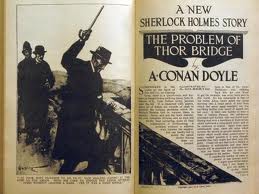
Of the Sherlock Holmes short stories, what is the minimum number necessary to outline Holmes' career? 

"A Scandal in Bohemia" and "His Last Bow" are the beginning and the end. The latter appropriately refers back to the former.

"The Final Problem" and "The Empty House" are the middle: the "death" and return.

"The Greek Interpreter," set before the "death," introduces Mycroft Holmes. "The Bruce-Partington Plans," set after the return, explains Mycroft's role in the Government. 

"His Last Bow" is a return from the retirement that is announced in "The Second Stain" and described in "The Lion's Mane."

Therefore, I think these eight are the minimum. "The Bruce-Partington Plans" and "The Second Stain" name certain foreign agents working in London. This links these stories directly to each other and indirectly to "His Last Bow" in which Holmes and Watson apprehend Von Bork who is as significant in international espionage as Moriarty was in national crime.

I would also include "The Red-headed League" and "The Naval Treaty." John Clay, who is behind the Red-headed League hoax, is high in London crime which means that Holmes must be well on the road to identifying Moriarty. At least two dramatizations have retroactively linked Moriarty to the Red-headed League. Holmes says that Clay is "the fourth smartest man in London." The three smartest must be Moriarty, Mycroft and Sherlock although Doyle was probably not thinking that when he wrote this story. 

"The Naval Treaty," coming between "The Greek Interpreter" and "The Final Problem," is a third story about an important stolen document and thus fits in with "The Bruce-Partington Plans" and "The Second Stain."

If we include the novels, then we must include them all. Holmes and Watson meet in A Study in Scarlet. Watson marries in The Sign of Four, thus explaining why he is not living at Baker Street in many of the stories starting with "A Scandal in Bohemia." The Valley of Fear, set before "The Final Problem," features a criminal gang who, although they are brought to justice, engage Moriarty to exact their revenge. Finally, The Hound of the Baskervilles, perhaps the novel that has been most often filmed, cannot be left out of any list of Holmes stories. 

007, No 6 and V

007 = 7; No 6 = 6; V = 5 in Roman numerals. Thus: 7, 6, 5.

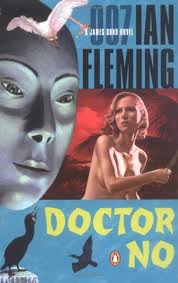
007 is James Bond in novels by Ian Fleming and his successors and in films starring Sean Connery and his successors. No 6 is the title character of Patrick McGoohan's The Prisoner TV series. V is the title character of Alan Moore's V for Vendetta graphic novel. (Three characters in four media: prose fiction (verbal); large and small screen drama (audiovisual); sequential art (visual-verbal).)

McGoohan borrowed from the James Bond films the idea of a powerful secret organisation with numbered members controlled by a mysterious "Number One." Moore did not borrow from McGoohan but did produce a parallel text addressing common themes. No 6 was so called because he was imprisoned in an island "Village" where he and his cottage were numbered 6. V was so called because he was imprisoned in Room V of a concentration camp. Later, fascist Britain resembled an island prison. V, a vendetta-waging anarchist terrorist, challenged the authorities as No 6 had challenged successive No 2's and the hidden No 1 in the Village. V was inspired by a letter passed between cells through a hole in the wall by the woman in Room IV. (Maintaining the numerical progression, Bond refers to a colleague numbered 008 and V refers to his fellow prisoner in Room IV.) We know of V only that he is male, not whether he is black, Jewish or homosexual or whether he was politically radical before his imprisonment.

Moore simultaneously wrote Marvelman and V, a superhero and a masked avenger, for Warrior magazine. Marvelman was directly descended, via Captain Marvel, from Superman whereas V was not directly descended from the archetypal comic book masked avenger, the Batman, although a Batman "Elseworld" story did show Wayne opposing an American dictatorship in an alternative history. V's appearance is based on that attributed to Guy Fawkes and he completes the job attempted by Fawkes. Like the Lone Ranger, V remains masked throughout. His face is unseen by the reader and even by his close assistant. In this respect at least, he also resembles Judge Dredd, a legalized vigilante in a futuristic city. (Moore also wrote an unpublished Dredd script, a "last Superman story" and a pivotal Batman/Joker story.)

In the Village, names are replaced by numbers but faces are not usually masked. When, in the episode "A, B and C," letters replace numbers, the previously unknown C leads No 6 to the masked D who, when unmasked, turns out to be the current No 2, but this occurs within an induced dream, thus in a "play within the play." In the concluding episode, No 6, unmasking No 1, significantly sees his own face. Prospero played by Vincent Price in the film The Masque of the Red Death had the same experience when he unmasked a red-garbed intruder who was his own personalized death.

At the end of V for Vendetta, V's assistant, Evey, does not unmask the dead V but realizes that her face must be behind the mask. She becomes V. His sabotage and assassinations have overthrown fascism. She hopefully will oversee without needing to intervene in the growth of freedom. But, like Asimov's Second Foundation, she and her new assistant will be able to intervene if necessary. In The Foundation Trilogy, an unpredictable mutant disrupted Seldon's Plan but the hidden Second Foundation existed to guard and restore the Plan. After the events of V for Vendetta, neo-fascists could seek to regain control. Evey/V might be able to prevent counter-revolution by encouraging more popular action. (She will not continue V1's strategy of individual assassinations.)

Bond conventionally contends with agents of a foreign dictatorship but does not change himself. The self-sufficient No 6 potentially frees himself. V, inspired by Valerie, and helped and succeeded by Evey, potentially frees society. Thus, the successive series form a progressive conceptual tetralogy:
 
first, Ian Fleming's twelve James Bond novels in which Bond mainly opposes Russian Intelligence (in fact, SPECTRE involvement in three of Fleming's later novels is film-derived); 

second, the first five Sean Connery James Bond films culminating in Bond's meeting with No 1, Ernst Stavro Blofeld, plus two further films with Blofeld as the acknowledged villain;

 
third, the seventeen episode Prisoner TV series culminating in the Prisoner's realization that he is the unmasked No 1;


fourth, the V for Vendetta graphic novel culminating in Evey's realization that she must be the masked V.

I exclude post-Fleming Bond novels, post-Connery Bond films, Prisoner spin-offs and the V for Vendetta film. At the time of writing, December 2009, I have not yet seen the new Prisoner TV series.


Who is V? When leading Evey to the roof of the building at the moment of her psychological liberation, he resembles a robed Christ but we should not regard a multiple manipulator and murderer as the Messiah. When addressing the public on video, he speaks as if he were mankind's creator but this is ironic. It has been suggested that V is Marvelman, who is deified in his own series. The only evidence for this identification, I think, is that, when seen in silhouette before donning the mask, V seems to be crew cut. Both V and MM result from, very different, government experiments. V's experience motivates him to overthrow that government. MM and his Pantheon are so powerful that they effortlessly displace the nuclear powers and the UN. V destroys a dystopia. MM builds a utopia. Their stories are complementary, not convergent. Like Superman (day) and Batman (night), they are archetypal opposites.
 
The anarchist V opposes all governments but has additional personal reasons to resist Norse Fire. He assassinates individuals not only because of their present positions in the state apparatus but also because of their past dealings with the man in Room V. For example, he forces the Bishop of London to consume a poisoned Communion wafer. The Bishop, who preached sermons dictated by the Fate computer to congregations including high Party members, had also previously been the concentration camp chaplain.

Much of the characterization, dialogue and plot in V for Vendetta is realistic but V's omniscience about the other characters is surreal. On the one hand, he is a particular character whose face was seen by his captors, though not by us, in the concentration camp. On the other hand, he is endlessly resourceful and manipulative and supremely confident that the state police will not find him hidden in the heart of London. Only the disaffected detective is going to find him and V somehow knows what the outcome of that encounter will be. He knows which Party widow will assassinate the Leader. Only the author can know so much about the characters. 
 
Authors can be incarnated in their stories. Very occasionally, the first person narrator really is the author. For example, CS Lewis exchanges letters with Ransom at the end of the first Ransom novel and meets him at the beginning of the second. But incarnated authors need not be narrators. The comic strip is mostly un-narrated and Alan Moore's incarnation in it is masked. Evey cannot see his face because she would have to look off the page to do so.