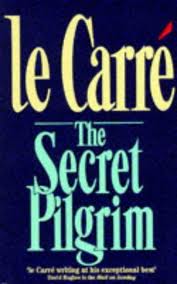
Twenty years ago, on 16 December 1991,
my car was off the road so I travelled from Lancaster to Merseyside by train.
There was a wait at Preston station so I bought the Guardian newspaper and
The Secret Pilgrim by John le Carre, published that year. On p. 11 of the
novel, the continuing character Toby Esterhase divulges that George Smiley is
chairing "...an informal working party made up of officers from Moscow Centre
and the Circus...to target the world's trouble spots..." (1) (The Circus is le
Carre's fictitious name for the Secret Intelligence Service, MI6.) The Guardian,
under the headline "Smiley's people train new class of spies from Eastern
Europe," reported that "...the Secret Intelligence Service, MI6..." had started
to train Eastern European agents following "...talks between Britain and east
European governments about the need to co-operate on security and intelligence
issues, particularly in the field of counter-terrorism." For once, events
reported in a newspaper corresponded to events occurring in a contemporaneously
published work of fiction. The fiction was up-to-date and even ahead of the
headlines. Later, I cut out the newspaper report, dated it and put it as a
bookmark between pages 10 and 11 of the novel.
Referring to the novel and its bookmark
now, I am reminded that the novel's dedication is "For Alec Guinness, with
affection and thanks." That is another reality-fiction interface. Le Carre said
in a radio interview that he stopped writing Smiley novels because Guinness had
defined the character so well on television that he, the author, was now writing
the character as portrayed by Guinness, not as originally conceived. Not that
there was a contradiction but that the author's imagination had now been
narrowed down to one view of the character as defined by the actor. To my
surprise, I see that, although its Editorial Office had a London address, the
publisher, Hodder and Stoughton Ltd, was based in Sevenoaks, Kent, where I lived
for a while.
Frederick Forsyth's equivalent post-Cold
War novel, which also involves an Intelligence officer looking back, is The
Deceiver. Forsyth writes with much knowledge of world affairs and the
British Establishment although his left wing characters are caricatures. In
The Deceiver, he informs us, accurately, that the SIS was founded by Admiral
Sir Mansfield Cumming. (2) He does not tell us here, though I think the
information is given in another Forsyth novel, that Cumming's successors were
referred to as "C." This became "M" in Fleming, "Control" in le Carre, "Mother"
in The Avengers TV series, "the Man" in an American spy series etc. Long
may fiction and reality intersect although they rarely do so as spectacularly as
they did in Preston station on 16 December 1991.
(1) John le Carre, The Secret Pilgrim,
London, 1991, p.11.
(2) Frederick Forsyth, The Deceiver, London, 1991, p. 19.


 Buchan's plots rely on too many
coincidences and implausible events, particularly in The Three Hostages.
Buchan's own political career seems to have obsessed him with the idea of
someone speaking publicly without preparation but carrying it off. This happens
at least three times in the novels. Buchan wrote from a different era when he
said of the then King of England not, "He liked my books," but "He did me the
honour to be amused by my romances." (An old edition of a HG Wells novel listing
other works by the same author included titles under not "Science Fiction" but
"Mr Wells has also written the following fantastic and imaginative romances: -")
Buchan's plots rely on too many
coincidences and implausible events, particularly in The Three Hostages.
Buchan's own political career seems to have obsessed him with the idea of
someone speaking publicly without preparation but carrying it off. This happens
at least three times in the novels. Buchan wrote from a different era when he
said of the then King of England not, "He liked my books," but "He did me the
honour to be amused by my romances." (An old edition of a HG Wells novel listing
other works by the same author included titles under not "Science Fiction" but
"Mr Wells has also written the following fantastic and imaginative romances: -")
